Serving all Ontario residents | In-person and virtual appointments available

Call us today

(647) 360-3294

Skip to content
Back to Blog

Emotional Development

Teaching Self-Regulation Skills to Children: A Parent’s Action Guide

A family spending time together in a warm and cozy room. A woman kneels on the floor, offering a fidget spinner to a child sitting on a bean bag who is holding a textured ball. In the background, a man smiles while sitting, with cushions, a knitted blanket, and a large window letting in natural light adding to the homey atmosphere.

When a child struggles to manage big feelings—whether it’s a preschooler melting down at the grocery store or a ten-year-old slamming doors after homework—parents often find themselves asking the same question: “How do I actually teach my child to handle this better?” We hear this question constantly from families who come through our doors, and the answer is both reassuring and empowering. Self-regulation isn’t a personality trait some children are born with and others aren’t. It’s a set of teachable skills that develop over time, through practice, connection, and patient guidance. The good news? You don’t need a psychology degree to teach these skills. What you need is a clear understanding of what self-regulation actually involves, realistic expectations for your child’s developmental stage, and practical strategies you can weave into everyday life. This guide is designed to give you exactly that—a parent’s action plan for building your child’s internal toolkit for managing attention, emotions, impulses, and flexible thinking from preschool through late elementary years.

What Self-Regulation Skills Actually Are (And Why They Matter)

Before we dive into teaching strategies, let’s get clear on what we’re actually building. Self-regulation is often confused with compliance—a child who follows rules because they’re afraid of consequences. But true self-regulation is something deeper. It’s the ability to monitor and manage thoughts, emotions, and behaviors in ways that fit the situation and support longer-term goals. A child with strong self-regulation can pause before reacting, tolerate frustration, shift attention when needed, and choose effective strategies when upset or tempted.

Family practicing bubble breathing together

Think of self-regulation as having four building blocks:

  • Attention control – The ability to focus, sustain concentration, and shift attention when needed
  • Emotional awareness – Recognizing and labeling feelings in oneself and others
  • Impulse control – Pausing before acting, resisting immediate gratification
  • Flexible thinking – Adapting to changes, considering alternatives, problem-solving

These aren’t separate compartments—they work together constantly. When your child waits patiently for their turn at a board game, they’re using attention control (staying engaged), impulse control (not grabbing the dice), and flexible thinking (adjusting their strategy based on what other players do). When they calm themselves down after losing, they’re drawing on emotional awareness and regulation strategies they’ve learned.

Why does this matter so much? Research consistently shows that children’s self-regulation predicts a wide range of outcomes—often more strongly than IQ or early academic skills. Children who enter school with stronger regulation tend to achieve higher reading and math scores, form better friendships, and show greater resilience under stress. They’re building the foundation for understanding your child’s emotional development in a way that will serve them throughout their lives.

Age-Appropriate Milestones: What to Expect and When

One of the most common sources of parental frustration is expecting regulation skills that haven’t yet developed. A four-year-old’s brain simply cannot do what an eight-year-old’s can. Understanding how self-regulation develops across childhood helps you calibrate your expectations and meet your child where they actually are.

Preschool (Ages 3-5)

  • Attention: Can focus on a single activity for 5-15 minutes with adult support
  • Emotional vocabulary: Knows basic feeling words (happy, sad, mad, scared)
  • Impulse control: Beginning to wait briefly, but still very challenging
  • Flexibility: Struggles with changes to routine or unexpected transitions

At this stage, children rely heavily on adult co-regulation. They’re just beginning to internalize the strategies you model.

Early Elementary (Ages 6-8)

  • Attention: Can sustain focus for 15-30 minutes on engaging tasks
  • Emotional vocabulary: Expanding to include frustrated, worried, embarrassed, excited
  • Impulse control: Can wait longer, follow multi-step instructions, resist some temptations
  • Flexibility: Beginning to adapt to changes with support, can consider simple alternatives

Children at this stage are building bridges between external support and internal control. They can start using strategies independently in low-stress situations.

Late Elementary (Ages 9-12)

  • Attention: Can focus for 30-45 minutes, especially on preferred activities
  • Emotional vocabulary: Nuanced words like overwhelmed, disappointed, anxious, hopeful
  • Impulse control: Better at delaying gratification, thinking before acting
  • Flexibility: Can generate multiple solutions, shift perspectives, plan ahead

Pre-teens are developing more sophisticated self-awareness and can engage in genuine reflection about their patterns and triggers.

Co-Regulation First: The Foundation for Everything

Here’s a truth that changes everything: children learn to regulate themselves by first being regulated with us. Before a child can calm themselves down, they need thousands of experiences of being calmed by a trusted adult. This is co-regulation—the way your calm, attuned presence helps your child’s nervous system settle.

When your child is dysregulated, their brain is often too flooded to access the logical, problem-solving parts. In those moments, they need you to be their external regulator. This doesn’t mean fixing the problem or explaining why they shouldn’t feel upset. It means:

  • Staying physically close and maintaining a calm presence
  • Using a warm, steady tone of voice
  • Limiting words—short, simple phrases work best
  • Acknowledging their feelings without judgment: “You’re really upset right now.”
  • Offering physical comfort if they’re receptive: a hand on the shoulder, sitting nearby

Think of it this way: your child borrows your nervous system until they’ve built their own. Every time you stay grounded while they fall apart, you’re teaching them that big feelings don’t destroy relationships and that emotions can be weathered.

This doesn’t mean you accept harmful behavior. You can hold a firm limit—”I won’t let you hit”—while still providing emotional safety. The limit is about behavior; the co-regulation is about the feeling underneath.

The crucial distinction is that co-regulation happens during emotional storms, while skill-teaching happens during calm moments. Trying to teach a breathing technique to a child in the middle of a meltdown is like trying to teach someone to swim while they’re drowning. Build the skills when the water is calm.

Teaching Emotional Awareness and Labeling

Children can’t regulate feelings they can’t name. Building emotional vocabulary and body awareness is the foundation for all regulation work. The developmental framework for self-regulation emphasizes that this awareness develops gradually through repeated practice and modeling.

For Preschoolers (Ages 3-5)

Feelings check-ins: At predictable moments (breakfast, bedtime), ask “How is your heart feeling right now?” Use a simple three-point scale: happy face, okay face, sad/mad face.

Emotion cards: Use picture cards showing faces with different emotions. Practice matching feelings to situations: “How might this bunny feel when his tower falls down?”

Simple body scan: “Let’s check in with your body. Does your tummy feel tight or relaxed? Are your shoulders up by your ears or down and soft?”

Teaching script: “I notice your hands are making fists and your voice is getting loud. I wonder if you’re feeling frustrated. Frustrated means when something isn’t working the way you want.”

For Early Elementary (Ages 6-8)

Emotion intensity scales: Use a 1-5 scale or a “feelings thermometer.” “Is your worry at a 2 (small butterfly) or a 4 (big stomachache)?”
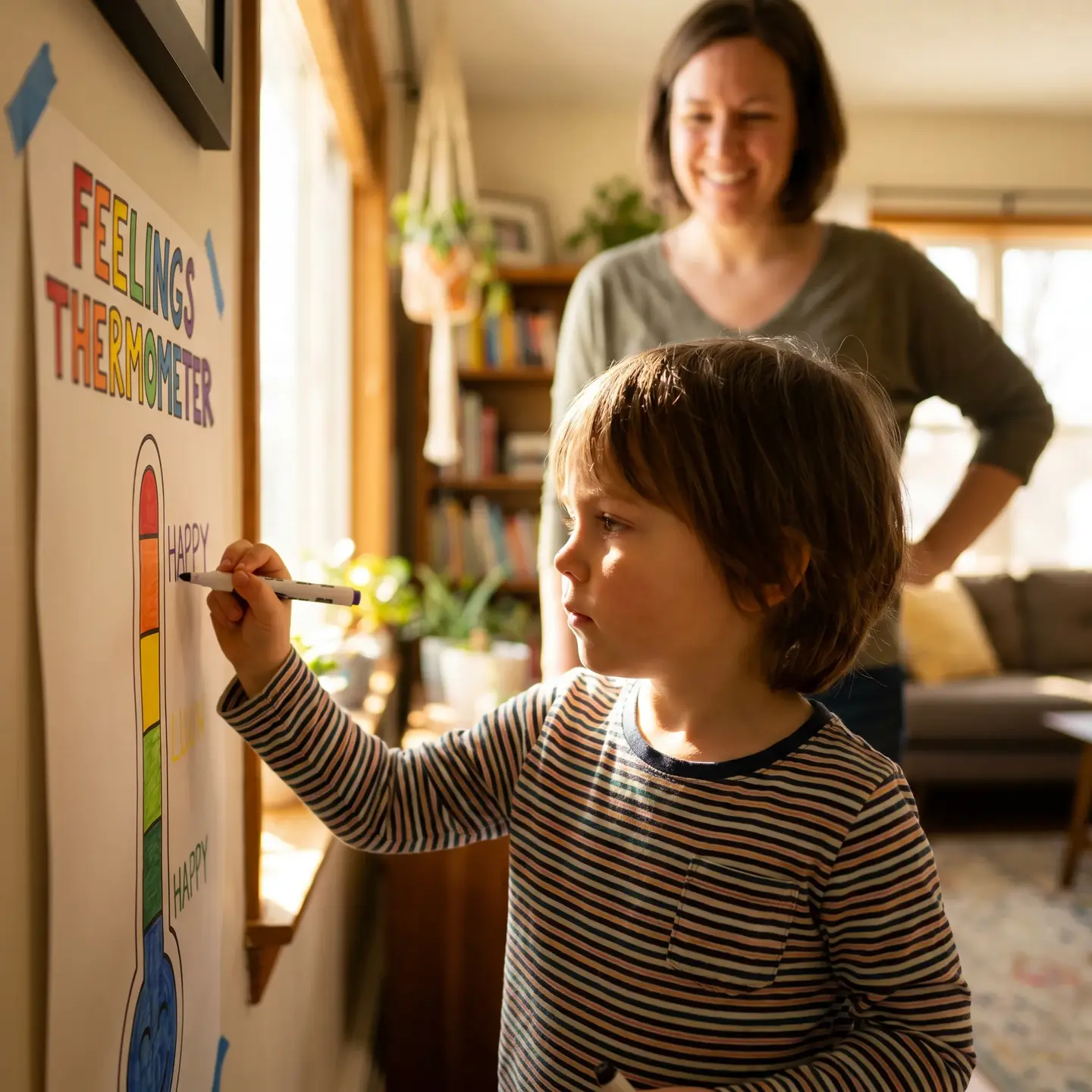
Child using feelings thermometer activity

Physical sensation mapping: Draw an outline of a body together. “When you feel nervous, where do you notice it? Let’s color that spot.”

Feeling-situation connections: “You felt disappointed when your friend couldn’t come over. What did disappointment feel like in your body?”

Teaching script: “It sounds like you’re feeling two things at once—excited about the party but also nervous about meeting new kids. Both feelings can be true at the same time.”

For Late Elementary (Ages 9-12)

Nuanced vocabulary building: Introduce words like overwhelmed, irritated, anxious, hopeful, conflicted. Discuss shades of meaning: “What’s the difference between annoyed and furious?”

Trigger identification: Help them notice patterns: “You seem to feel most overwhelmed on Sunday nights. What do you think that’s about?”

Multiple simultaneous feelings: “It makes sense that you’re proud of making the team and also nervous about whether you’ll be good enough. Those feelings can live together.”

Body-Based Regulation Strategies

The body is the fastest route to regulation. When children learn to calm their nervous system through breathing, movement, and sensory input, they gain powerful tools they can use anywhere. These evidence-based strategies for teaching regulation work because they directly influence the body’s stress response.

For Preschoolers (Ages 3-5)

Bubble breathing: “Pretend you’re blowing bubbles. Take a big breath in through your nose, then blow out slowly and gently so the bubble doesn’t pop.” Practice 3-5 breaths.

Heavy work activities: Pushing, pulling, carrying, and climbing all provide organizing sensory input. “Can you help me push this laundry basket to the bedroom?” or “Let’s do wall push-ups together.”

Sensory tools: Playdough, water play, and kinetic sand can be calming. Keep a small sensory bin accessible.

For Early Elementary (Ages 6-8)

Box breathing: Draw a square. “Breathe in for 4 counts (trace up), hold for 4 (trace across), breathe out for 4 (trace down), hold for 4 (trace across).”

Movement breaks: When you notice energy rising, offer structured movement: “Let’s do 10 jumping jacks, then 10 slow squats.” The combination of fast and slow helps the nervous system reset.

Personal fidget toolkit: Work together to identify what helps: stress ball, textured fabric, fidget cube. Keep these accessible but teach when and where to use them.

For Late Elementary (Ages 9-12)

Progressive muscle relaxation: “Squeeze your fists as tight as you can for 5 seconds… now release. Notice the difference between tense and relaxed.” Move through major muscle groups.

Personalized calming sequence: Help them create their own regulation routine. “When you notice your stress level rising, what’s your three-step plan?” They might choose: take 5 deep breaths, get a drink of water, do 20 jumping jacks.

Exercise routines: Physical activity is one of the most powerful regulation tools for this age. Support regular movement they enjoy.

Cognitive Regulation Skills

As children develop, they can use thinking strategies to manage emotions—self-talk, problem-solving, and perspective-taking. These skills build on the emotional awareness and body-based foundations.

For Preschoolers (Ages 3-5)

Simple self-talk phrases: Teach 2-3 phrases they can use when frustrated: “I can do hard things,” “I can ask for help,” “I can try again.”

Two-option problem-solving: “Your sister has the toy you want. You could wait for a turn, or you could play with something else while you wait. Which would you like to try?”

For Early Elementary (Ages 6-8)

Positive self-statements: Help them create personal mantras: “Mistakes help me learn,” “This feeling will pass,” “I can handle hard things.”

STEP problem-solving:

  1. Stop and identify the problem
  2. Think of three possible solutions
  3. Evaluate each one—what might happen?
  4. Pick one and try it

Simple perspective-taking: “How do you think your friend felt when that happened? What clues tell you that?”

For Late Elementary (Ages 9-12)

Cognitive reframing: “You’re thinking ‘I’m going to fail this test.’ Is that definitely true? What’s another way to think about it? Maybe: ‘I’m nervous about this test, but I studied and I’ll do my best.'”

Evaluating solutions: When problem-solving, help them consider short-term and long-term consequences, effects on relationships, and alignment with their values.

Complex perspective-taking: “Your teacher seemed frustrated today. What might be going on for her? How might that affect how she responds to the class?”

Environmental Supports That Teach Regulation

The structure of your home environment can either support or undermine regulation skill development. When we reduce cognitive load through predictability, we free up mental resources for children to practice new skills.

Visual Schedules

Create simple picture schedules for challenging parts of the day (morning routine, after-school, bedtime). For older children, a written checklist works well. This builds time awareness and reduces power struggles around transitions.

Calm-Down Spaces

Designate a cozy corner with regulation tools appropriate to your child’s age: soft pillows, fidget toys, books about feelings, breathing reminder cards. This isn’t a “time-out” spot—it’s a place children can choose to go when they need to reset. Practice using it during calm times so it becomes familiar.

Predictable Routines

Consistent daily rhythms reduce the demand on children’s regulatory systems. When a child knows what comes next, they don’t have to spend mental energy managing uncertainty. This is especially important for children who tend toward anxiety or who have strong-willed temperaments that resist change.

Practice Activities and Games

Regulation skills strengthen through practice, and play is the most natural practice ground for young children. Here are games that target specific skills:

For Preschoolers

  • Red Light, Green Light / Freeze Dance: Practices impulse control and stop-start regulation
  • Simon Says: Builds attention control and inhibition
  • Emotion Charades: Develops emotional awareness through playful identification
  • Slow-motion races: Walking or moving in slow motion builds self-control

For Early Elementary

  • Mindfulness games: “Listening for sounds” (close eyes, notice 5 sounds), “Mindful eating” (describe a raisin using all senses)
  • Impulse control challenges: “Don’t laugh” contests, keeping a straight face while someone tries to make you smile
  • Cooperative board games: Games where players work together toward a common goal build flexibility and frustration tolerance

For Late Elementary

  • Goal-setting projects: Choose a personal goal, break it into steps, track progress—builds planning and persistence
  • Reflection journals: Brief daily writing about what went well, what was challenging, what they’ll try tomorrow
  • Strategy games: Chess, complex card games, and strategy video games (with time limits) practice flexible thinking and impulse control

Your 4-Week Skill-Building Roadmap

Here’s a simple framework for introducing regulation skills systematically. Adapt the specific activities based on your child’s age using the suggestions above.

Week 1: Emotional Awareness Focus

  • Introduce daily feelings check-ins (2-3 minutes at a consistent time)
  • Practice naming emotions as they come up naturally throughout the day
  • Read one book about feelings together

Week 2: Body-Based Strategies

  • Teach one breathing technique; practice together daily (5 minutes)
  • Introduce the calm-down space if you haven’t already
  • Notice and narrate body sensations connected to emotions

Week 3: Cognitive Tools

  • Introduce one self-talk phrase or problem-solving framework
  • Practice during low-stakes situations
  • Play one regulation-building game together

Week 4: Integration and Practice

  • Create a personal “regulation plan” with your child: “When I feel [upset], I can try [strategy 1], [strategy 2], or [strategy 3].”
  • Practice using the plan during mild frustrations
  • Celebrate effort and progress, not perfection

When to Seek Professional Support

Sometimes, despite your best efforts, a child’s regulation challenges persist or intensify in ways that affect daily functioning. It’s important to distinguish between typical developmental variation and patterns that may benefit from professional assessment.

Consider reaching out for support if you notice:

  • Frequent intense meltdowns that continue well past age 5-6
  • Regulation difficulties significantly more intense than peers
  • Challenges affecting school performance, friendships, or family relationships
  • Your child expressing hopelessness, excessive worry, or other concerning thoughts
  • Strategies that work for most children consistently not working for yours

Children with ADHD, autism, or anxiety often need more intensive, specialized support for regulation skill-building. This isn’t a failure of parenting—it’s recognition that some children’s nervous systems require additional scaffolding. Our parent coaching services can help you understand whether what you’re seeing falls within typical range or warrants further evaluation. For children ages 9-10 who are struggling significantly, individual therapy can provide targeted skill-building in a supportive environment.

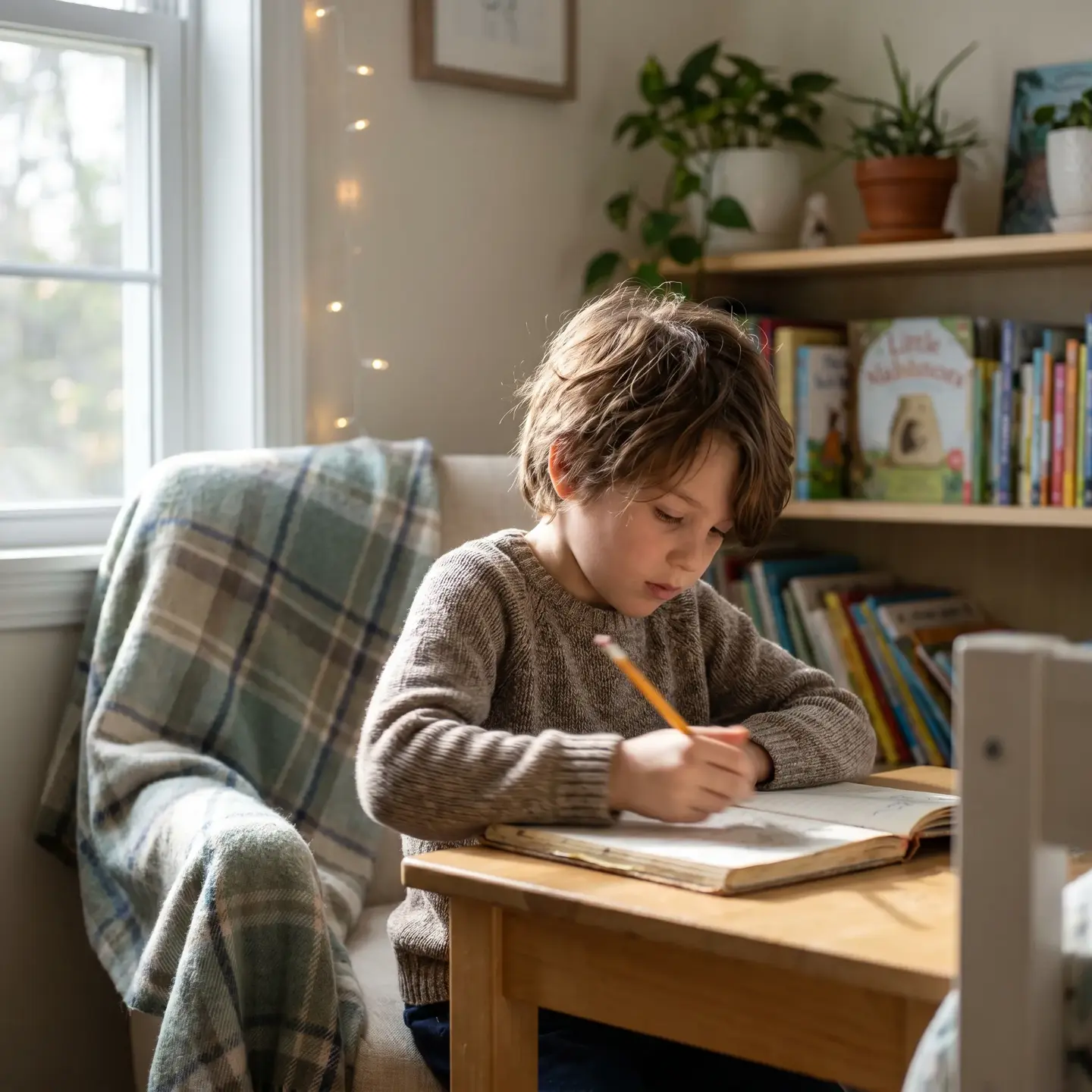
Child journaling about regulation skills

The Long View: Building Regulation Over Time

Teaching self-regulation isn’t a quick fix—it’s a years-long process of patient practice, repeated repair, and gradual skill-building. There will be setbacks. There will be days when everything you’ve practiced seems to disappear. This is normal.

What matters is the overall trajectory. A child who has a meltdown but recovers more quickly than last month is making progress. A child who can sometimes use a breathing technique, even if not always, is building capacity. A child who can name their feelings, even after the fact, is developing awareness.

Your role isn’t to prevent all dysregulation or to produce a perfectly controlled child. Your role is to be the steady, warm presence that helps your child build their own internal toolkit—one practice, one connection, one repaired moment at a time. When you approach this work with patience and self-compassion, you’re not only teaching your child regulation skills; you’re showing them what it looks like to be human, imperfect, and committed to growth.

For more guidance on Understanding Your Child and the emotional development underlying these skills, explore our resources designed to help parents see their child’s behavior through a developmental lens. Every child can build stronger regulation with the right support—and every parent has the capacity to provide it.

Frequently Asked Questions

A calm-down space is a cozy, inviting area kids choose to use to feel better, with tools like pillows, books, or fidgets. It’s about support and skill-building. A time-out spot usually feels like isolation or punishment. For regulation, you want a space that feels safe and comforting.

Look at both intensity and impact. It’s typical for preschoolers to have frequent big meltdowns, but by ages 6–8, most kids recover more quickly and use basic coping strategies. If outbursts stay very intense past ages 5–6, are much bigger than their peers’, or regularly disrupt school, friendships, or family life, it may be time to seek professional support.

Pick one focus at a time and practice it briefly each day. Try this simple 4-week plan: Week 1, name feelings; Week 2, learn one breathing strategy; Week 3, add one self-talk phrase or problem-solving step; Week 4, create a simple plan together. Small, consistent practice beats doing everything at once.

Not at all. Self-regulation develops over years, not weeks, and some children—especially those with ADHD, autism, or anxiety—need more repetition and support. If everyday strategies consistently don’t help, or your child seems stuck, that’s a sign to get extra guidance, not a reflection of your parenting effort.

During a meltdown, focus on connection, not teaching. Stay close, keep your voice calm and simple, and validate their feelings while holding firm limits on unsafe behavior. Save skill-building—like breathing or problem-solving—for later, when your child is calm enough to think and learn.

Ola Obaro
Ola Obaro
Ola Obaro is a registered psychotherapist at FFEW with over a decade of clinical experience working with children, parents, and families. She specializes in Circle of Security and the Gordon Neufeld approach, bringing a multicultural perspective shaped by her work supporting immigrant families. Ola leads FFEW's Building Blocks and Courageous & Connected group programs for parents.

Take the first step toward calm, connected parenting

You don’t have to keep guessing. With the right tools and support, parenting can feel easier—and your child can thrive.

Book a Free Consultation


How we Treat

What we Treat

Teaching Self-Regulation Skills to Children: A Parent’s Action Guide

Emotional Development

By: Ola

A family spending time together in a warm and cozy room. A woman kneels on the floor, offering a fidget spinner to a child sitting on a bean bag who is holding a textured ball. In the background, a man smiles while sitting, with cushions, a knitted blanket, and a large window letting in natural light adding to the homey atmosphere.

When a child struggles to manage big feelings—whether it’s a preschooler melting down at the grocery store or a ten-year-old slamming doors after homework—parents often find themselves asking the same question: “How do I actually teach my child to handle this better?” We hear this question constantly from families who come through our doors, and the answer is both reassuring and empowering. Self-regulation isn’t a personality trait some children are born with and others aren’t. It’s a set of teachable skills that develop over time, through practice, connection, and patient guidance. The good news? You don’t need a psychology degree to teach these skills. What you need is a clear understanding of what self-regulation actually involves, realistic expectations for your child’s developmental stage, and practical strategies you can weave into everyday life. This guide is designed to give you exactly that—a parent’s action plan for building your child’s internal toolkit for managing attention, emotions, impulses, and flexible thinking from preschool through late elementary years.

What Self-Regulation Skills Actually Are (And Why They Matter)

Before we dive into teaching strategies, let’s get clear on what we’re actually building. Self-regulation is often confused with compliance—a child who follows rules because they’re afraid of consequences. But true self-regulation is something deeper. It’s the ability to monitor and manage thoughts, emotions, and behaviors in ways that fit the situation and support longer-term goals. A child with strong self-regulation can pause before reacting, tolerate frustration, shift attention when needed, and choose effective strategies when upset or tempted.

Family practicing bubble breathing together

Think of self-regulation as having four building blocks:

  • Attention control – The ability to focus, sustain concentration, and shift attention when needed
  • Emotional awareness – Recognizing and labeling feelings in oneself and others
  • Impulse control – Pausing before acting, resisting immediate gratification
  • Flexible thinking – Adapting to changes, considering alternatives, problem-solving

These aren’t separate compartments—they work together constantly. When your child waits patiently for their turn at a board game, they’re using attention control (staying engaged), impulse control (not grabbing the dice), and flexible thinking (adjusting their strategy based on what other players do). When they calm themselves down after losing, they’re drawing on emotional awareness and regulation strategies they’ve learned.

Why does this matter so much? Research consistently shows that children’s self-regulation predicts a wide range of outcomes—often more strongly than IQ or early academic skills. Children who enter school with stronger regulation tend to achieve higher reading and math scores, form better friendships, and show greater resilience under stress. They’re building the foundation for understanding your child’s emotional development in a way that will serve them throughout their lives.

Age-Appropriate Milestones: What to Expect and When

One of the most common sources of parental frustration is expecting regulation skills that haven’t yet developed. A four-year-old’s brain simply cannot do what an eight-year-old’s can. Understanding how self-regulation develops across childhood helps you calibrate your expectations and meet your child where they actually are.

Preschool (Ages 3-5)

  • Attention: Can focus on a single activity for 5-15 minutes with adult support
  • Emotional vocabulary: Knows basic feeling words (happy, sad, mad, scared)
  • Impulse control: Beginning to wait briefly, but still very challenging
  • Flexibility: Struggles with changes to routine or unexpected transitions

At this stage, children rely heavily on adult co-regulation. They’re just beginning to internalize the strategies you model.

Early Elementary (Ages 6-8)

  • Attention: Can sustain focus for 15-30 minutes on engaging tasks
  • Emotional vocabulary: Expanding to include frustrated, worried, embarrassed, excited
  • Impulse control: Can wait longer, follow multi-step instructions, resist some temptations
  • Flexibility: Beginning to adapt to changes with support, can consider simple alternatives

Children at this stage are building bridges between external support and internal control. They can start using strategies independently in low-stress situations.

Late Elementary (Ages 9-12)

  • Attention: Can focus for 30-45 minutes, especially on preferred activities
  • Emotional vocabulary: Nuanced words like overwhelmed, disappointed, anxious, hopeful
  • Impulse control: Better at delaying gratification, thinking before acting
  • Flexibility: Can generate multiple solutions, shift perspectives, plan ahead

Pre-teens are developing more sophisticated self-awareness and can engage in genuine reflection about their patterns and triggers.

Co-Regulation First: The Foundation for Everything

Here’s a truth that changes everything: children learn to regulate themselves by first being regulated with us. Before a child can calm themselves down, they need thousands of experiences of being calmed by a trusted adult. This is co-regulation—the way your calm, attuned presence helps your child’s nervous system settle.

When your child is dysregulated, their brain is often too flooded to access the logical, problem-solving parts. In those moments, they need you to be their external regulator. This doesn’t mean fixing the problem or explaining why they shouldn’t feel upset. It means:

  • Staying physically close and maintaining a calm presence
  • Using a warm, steady tone of voice
  • Limiting words—short, simple phrases work best
  • Acknowledging their feelings without judgment: “You’re really upset right now.”
  • Offering physical comfort if they’re receptive: a hand on the shoulder, sitting nearby

Think of it this way: your child borrows your nervous system until they’ve built their own. Every time you stay grounded while they fall apart, you’re teaching them that big feelings don’t destroy relationships and that emotions can be weathered.

This doesn’t mean you accept harmful behavior. You can hold a firm limit—”I won’t let you hit”—while still providing emotional safety. The limit is about behavior; the co-regulation is about the feeling underneath.

The crucial distinction is that co-regulation happens during emotional storms, while skill-teaching happens during calm moments. Trying to teach a breathing technique to a child in the middle of a meltdown is like trying to teach someone to swim while they’re drowning. Build the skills when the water is calm.

Teaching Emotional Awareness and Labeling

Children can’t regulate feelings they can’t name. Building emotional vocabulary and body awareness is the foundation for all regulation work. The developmental framework for self-regulation emphasizes that this awareness develops gradually through repeated practice and modeling.

For Preschoolers (Ages 3-5)

Feelings check-ins: At predictable moments (breakfast, bedtime), ask “How is your heart feeling right now?” Use a simple three-point scale: happy face, okay face, sad/mad face.

Emotion cards: Use picture cards showing faces with different emotions. Practice matching feelings to situations: “How might this bunny feel when his tower falls down?”

Simple body scan: “Let’s check in with your body. Does your tummy feel tight or relaxed? Are your shoulders up by your ears or down and soft?”

Teaching script: “I notice your hands are making fists and your voice is getting loud. I wonder if you’re feeling frustrated. Frustrated means when something isn’t working the way you want.”

For Early Elementary (Ages 6-8)

Emotion intensity scales: Use a 1-5 scale or a “feelings thermometer.” “Is your worry at a 2 (small butterfly) or a 4 (big stomachache)?”

Child using feelings thermometer activity

Physical sensation mapping: Draw an outline of a body together. “When you feel nervous, where do you notice it? Let’s color that spot.”

Feeling-situation connections: “You felt disappointed when your friend couldn’t come over. What did disappointment feel like in your body?”

Teaching script: “It sounds like you’re feeling two things at once—excited about the party but also nervous about meeting new kids. Both feelings can be true at the same time.”

For Late Elementary (Ages 9-12)

Nuanced vocabulary building: Introduce words like overwhelmed, irritated, anxious, hopeful, conflicted. Discuss shades of meaning: “What’s the difference between annoyed and furious?”

Trigger identification: Help them notice patterns: “You seem to feel most overwhelmed on Sunday nights. What do you think that’s about?”

Multiple simultaneous feelings: “It makes sense that you’re proud of making the team and also nervous about whether you’ll be good enough. Those feelings can live together.”

Body-Based Regulation Strategies

The body is the fastest route to regulation. When children learn to calm their nervous system through breathing, movement, and sensory input, they gain powerful tools they can use anywhere. These evidence-based strategies for teaching regulation work because they directly influence the body’s stress response.

For Preschoolers (Ages 3-5)

Bubble breathing: “Pretend you’re blowing bubbles. Take a big breath in through your nose, then blow out slowly and gently so the bubble doesn’t pop.” Practice 3-5 breaths.

Heavy work activities: Pushing, pulling, carrying, and climbing all provide organizing sensory input. “Can you help me push this laundry basket to the bedroom?” or “Let’s do wall push-ups together.”

Sensory tools: Playdough, water play, and kinetic sand can be calming. Keep a small sensory bin accessible.

For Early Elementary (Ages 6-8)

Box breathing: Draw a square. “Breathe in for 4 counts (trace up), hold for 4 (trace across), breathe out for 4 (trace down), hold for 4 (trace across).”

Movement breaks: When you notice energy rising, offer structured movement: “Let’s do 10 jumping jacks, then 10 slow squats.” The combination of fast and slow helps the nervous system reset.

Personal fidget toolkit: Work together to identify what helps: stress ball, textured fabric, fidget cube. Keep these accessible but teach when and where to use them.

For Late Elementary (Ages 9-12)

Progressive muscle relaxation: “Squeeze your fists as tight as you can for 5 seconds… now release. Notice the difference between tense and relaxed.” Move through major muscle groups.

Personalized calming sequence: Help them create their own regulation routine. “When you notice your stress level rising, what’s your three-step plan?” They might choose: take 5 deep breaths, get a drink of water, do 20 jumping jacks.

Exercise routines: Physical activity is one of the most powerful regulation tools for this age. Support regular movement they enjoy.

Cognitive Regulation Skills

As children develop, they can use thinking strategies to manage emotions—self-talk, problem-solving, and perspective-taking. These skills build on the emotional awareness and body-based foundations.

For Preschoolers (Ages 3-5)

Simple self-talk phrases: Teach 2-3 phrases they can use when frustrated: “I can do hard things,” “I can ask for help,” “I can try again.”

Two-option problem-solving: “Your sister has the toy you want. You could wait for a turn, or you could play with something else while you wait. Which would you like to try?”

For Early Elementary (Ages 6-8)

Positive self-statements: Help them create personal mantras: “Mistakes help me learn,” “This feeling will pass,” “I can handle hard things.”

STEP problem-solving:

  1. Stop and identify the problem
  2. Think of three possible solutions
  3. Evaluate each one—what might happen?
  4. Pick one and try it

Simple perspective-taking: “How do you think your friend felt when that happened? What clues tell you that?”

For Late Elementary (Ages 9-12)

Cognitive reframing: “You’re thinking ‘I’m going to fail this test.’ Is that definitely true? What’s another way to think about it? Maybe: ‘I’m nervous about this test, but I studied and I’ll do my best.'”

Evaluating solutions: When problem-solving, help them consider short-term and long-term consequences, effects on relationships, and alignment with their values.

Complex perspective-taking: “Your teacher seemed frustrated today. What might be going on for her? How might that affect how she responds to the class?”

Environmental Supports That Teach Regulation

The structure of your home environment can either support or undermine regulation skill development. When we reduce cognitive load through predictability, we free up mental resources for children to practice new skills.

Visual Schedules

Create simple picture schedules for challenging parts of the day (morning routine, after-school, bedtime). For older children, a written checklist works well. This builds time awareness and reduces power struggles around transitions.

Calm-Down Spaces

Designate a cozy corner with regulation tools appropriate to your child’s age: soft pillows, fidget toys, books about feelings, breathing reminder cards. This isn’t a “time-out” spot—it’s a place children can choose to go when they need to reset. Practice using it during calm times so it becomes familiar.

Predictable Routines

Consistent daily rhythms reduce the demand on children’s regulatory systems. When a child knows what comes next, they don’t have to spend mental energy managing uncertainty. This is especially important for children who tend toward anxiety or who have strong-willed temperaments that resist change.

Practice Activities and Games

Regulation skills strengthen through practice, and play is the most natural practice ground for young children. Here are games that target specific skills:

For Preschoolers

  • Red Light, Green Light / Freeze Dance: Practices impulse control and stop-start regulation
  • Simon Says: Builds attention control and inhibition
  • Emotion Charades: Develops emotional awareness through playful identification
  • Slow-motion races: Walking or moving in slow motion builds self-control

For Early Elementary

  • Mindfulness games: “Listening for sounds” (close eyes, notice 5 sounds), “Mindful eating” (describe a raisin using all senses)
  • Impulse control challenges: “Don’t laugh” contests, keeping a straight face while someone tries to make you smile
  • Cooperative board games: Games where players work together toward a common goal build flexibility and frustration tolerance

For Late Elementary

  • Goal-setting projects: Choose a personal goal, break it into steps, track progress—builds planning and persistence
  • Reflection journals: Brief daily writing about what went well, what was challenging, what they’ll try tomorrow
  • Strategy games: Chess, complex card games, and strategy video games (with time limits) practice flexible thinking and impulse control

Your 4-Week Skill-Building Roadmap

Here’s a simple framework for introducing regulation skills systematically. Adapt the specific activities based on your child’s age using the suggestions above.

Week 1: Emotional Awareness Focus

  • Introduce daily feelings check-ins (2-3 minutes at a consistent time)
  • Practice naming emotions as they come up naturally throughout the day
  • Read one book about feelings together

Week 2: Body-Based Strategies

  • Teach one breathing technique; practice together daily (5 minutes)
  • Introduce the calm-down space if you haven’t already
  • Notice and narrate body sensations connected to emotions

Week 3: Cognitive Tools

  • Introduce one self-talk phrase or problem-solving framework
  • Practice during low-stakes situations
  • Play one regulation-building game together

Week 4: Integration and Practice

  • Create a personal “regulation plan” with your child: “When I feel [upset], I can try [strategy 1], [strategy 2], or [strategy 3].”
  • Practice using the plan during mild frustrations
  • Celebrate effort and progress, not perfection

When to Seek Professional Support

Sometimes, despite your best efforts, a child’s regulation challenges persist or intensify in ways that affect daily functioning. It’s important to distinguish between typical developmental variation and patterns that may benefit from professional assessment.

Consider reaching out for support if you notice:

  • Frequent intense meltdowns that continue well past age 5-6
  • Regulation difficulties significantly more intense than peers
  • Challenges affecting school performance, friendships, or family relationships
  • Your child expressing hopelessness, excessive worry, or other concerning thoughts
  • Strategies that work for most children consistently not working for yours

Children with ADHD, autism, or anxiety often need more intensive, specialized support for regulation skill-building. This isn’t a failure of parenting—it’s recognition that some children’s nervous systems require additional scaffolding. Our parent coaching services can help you understand whether what you’re seeing falls within typical range or warrants further evaluation. For children ages 9-10 who are struggling significantly, individual therapy can provide targeted skill-building in a supportive environment.

Child journaling about regulation skills

The Long View: Building Regulation Over Time

Teaching self-regulation isn’t a quick fix—it’s a years-long process of patient practice, repeated repair, and gradual skill-building. There will be setbacks. There will be days when everything you’ve practiced seems to disappear. This is normal.

What matters is the overall trajectory. A child who has a meltdown but recovers more quickly than last month is making progress. A child who can sometimes use a breathing technique, even if not always, is building capacity. A child who can name their feelings, even after the fact, is developing awareness.

Your role isn’t to prevent all dysregulation or to produce a perfectly controlled child. Your role is to be the steady, warm presence that helps your child build their own internal toolkit—one practice, one connection, one repaired moment at a time. When you approach this work with patience and self-compassion, you’re not only teaching your child regulation skills; you’re showing them what it looks like to be human, imperfect, and committed to growth.

For more guidance on Understanding Your Child and the emotional development underlying these skills, explore our resources designed to help parents see their child’s behavior through a developmental lens. Every child can build stronger regulation with the right support—and every parent has the capacity to provide it.

Understanding how Emotions Function: Learn to Ride your Child’s Wave

Understanding how emotions function in humans has been instrumental in guiding how I parent my three children, and it’…

Read more

Nurturing Emotional Expression in Children

In my years of working with families, I’ve noticed there are some children whose emotions are clear and observable…

Read more

How to Decode Your Child’s Emotional Messages

When my youngest son was 8, he came home from school, slammed his backpack on the floor, and proceeded to move into a di…

Read more