

Guide to Preventive Care: Early Intervention in Child Emotional Health
Early intervention, specifically preventive care, plays an integral role in fostering emotional wellness in children. Th…
Read more
Mental Health & Mood

When your child asks for the fourth time today whether a headache means something serious, or when your teenager spends another evening scrolling through symptoms online instead of finishing homework, you might wonder whether this level of worry is typical. A passing concern about getting sick is part of growing up. But when the worry takes up more and more space, when it shapes what your child does and does not do, and when your reassurance seems to help for only a few minutes before the questions start again, something different may be happening. This is health anxiety, and it can look quite different in children than it does in adults.
This article is for parents and caregivers of children and teens, roughly ages 6 to 17, who have noticed a pattern of worry about illness that seems out of proportion to any actual health problem. It is also for families who feel caught in a loop of answering the same health questions again and again without the worry getting better.

This article is not a substitute for medical advice. If your child has new, changing, or persistent physical symptoms, the first step is always a visit to your family doctor or paediatrician. We are not here to diagnose, and we are not here to tell you to ignore what your child’s body is telling them. We are here to help you understand when worry itself might be part of the problem, and what you can do at home while you figure out next steps.
Health anxiety is more than just being careful during cold and flu season or feeling nervous before a doctor’s appointment. According to the NHS information on health anxiety, it involves spending so much time worrying about being ill, or becoming ill, that it starts to take over daily life. It is related to obsessive-compulsive disorder and often involves checking the body, seeking reassurance, worrying that doctors missed something, and avoiding anything linked to illness.
In children, health anxiety often shows up as:
What makes this different from ordinary caution is the persistence and the way it starts to shrink your child’s world. A child with health anxiety might skip a birthday party because someone there had a cold last week. They might lie awake asking the same question about a headache that you have already answered honestly. They might feel relief when you check their forehead, but the relief fades quickly and the questions return.
Health anxiety does not look the same in a six-year-old and a fifteen-year-old. Understanding what to watch for at different stages can help you respond in a way that fits your child’s development.
At this age, children may not be able to name the illness they are afraid of. Instead, you might see:
Children in this age group can think more abstractly about illness and may have more specific fears. Watch for:

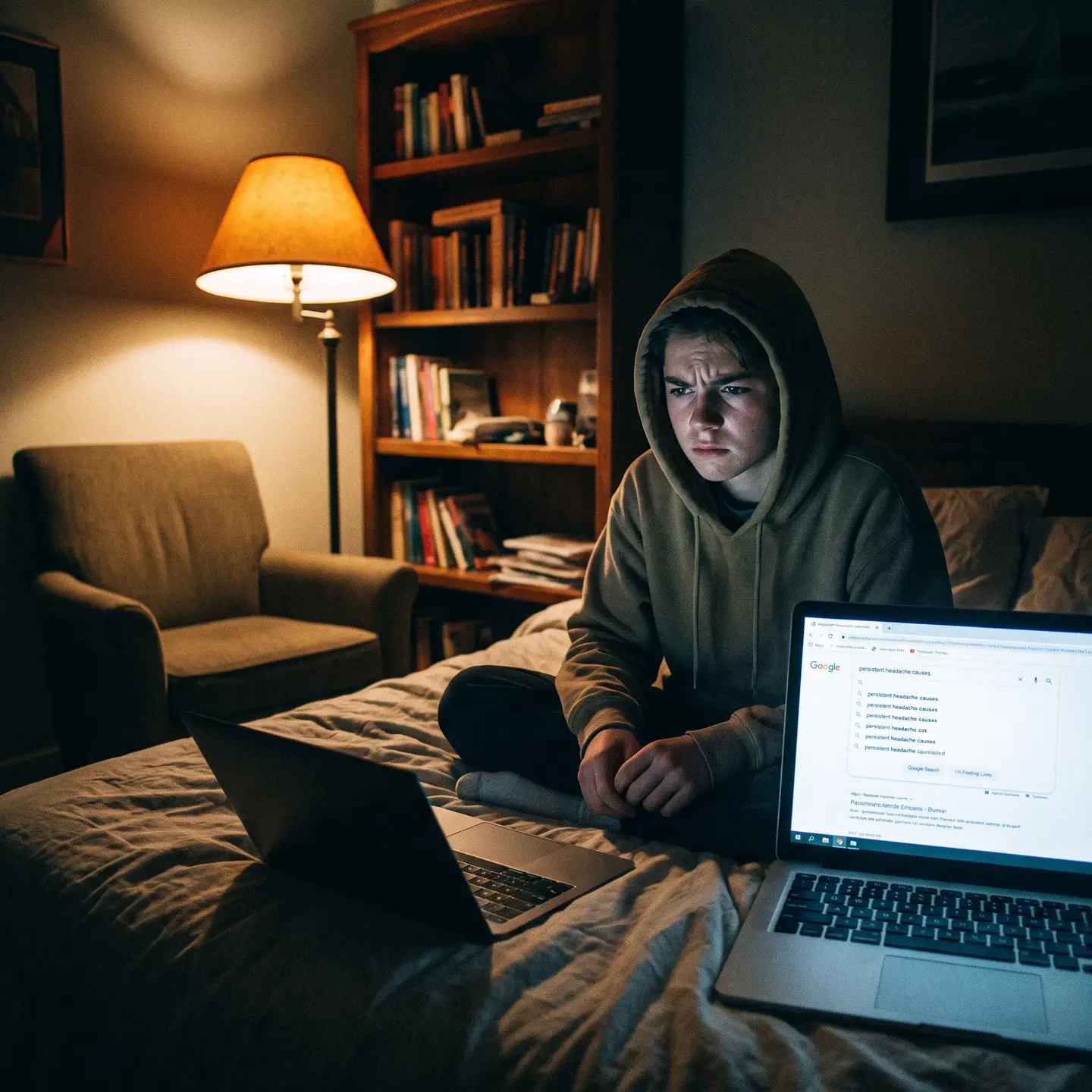
Adolescents are more likely to keep their worries private and to use the internet to manage their anxiety. Signs include:
One of the most confusing parts of health anxiety is that the physical symptoms are real. Anxiety itself can cause stomach aches, nausea, a faster heartbeat, muscle tension, dizziness, and headaches. AboutKidsHealth on signs and symptoms of anxiety in children lists all of these as common physical signs of anxiety in young people.
This creates a trap. Your child notices a symptom, worries about what it means, and the worry itself produces more symptoms. They feel their heart speed up, which makes them more afraid, which makes their heart beat even faster. By the time they ask you whether something is wrong, they genuinely feel unwell.
We have written more about this connection between anxiety and stomach troubles in our article on when tummy aches signal anxiety. The short version is this: believing your child’s discomfort is real and recognizing that anxiety is driving it are not opposites. Both can be true at the same time.
When your child asks whether they are okay, it is natural to want to comfort them. And the first time you answer, it probably helps. The problem comes when the same question returns ten minutes later, or the next morning, or every single night. Reassurance works in the short term but stops working over time because it teaches your child that the only way to feel better is to get more certainty from you.
This is sometimes called the reassurance trap, and it is one of the most common patterns we see in families dealing with anxiety in children and teens.
The cycle often looks like this:
The more you reassure, the more your child learns that uncertainty is unbearable and that only your answer can make things okay. Over time, this keeps the anxiety in charge.
The goal is not to ignore your child’s distress or to refuse to answer any questions. The goal is to give one honest, calm answer and then help your child practise sitting with the uncomfortable feeling that comes when they do not get repeated reassurance.
The first time your child asks a health question, answer it directly and honestly. Do not make promises you cannot keep, such as “You will definitely not get sick.” According to AboutKidsHealth overview of anxiety in children, children benefit from direct, honest answers without false guarantees.
When the question returns, acknowledge the worry without giving more reassurance:
This is not about being cold. It is about showing your child that you believe they can handle the discomfort and that you will stay close while they do.
For some children, having a set time to talk about worries can help contain them. You might agree to spend ten minutes after dinner discussing health concerns, and outside that time, questions get saved for “worry time.” This gives your child a place to put the worry without letting it take over the whole day.
If your child has started avoiding school, sports, friends, or places because of health fears, work on returning to those activities slowly. Start with something manageable, repeat it until it feels less scary, and then take the next step. This kind of gradual exposure is one of the most effective ways to help anxiety lose its grip.
For older children and teens, compulsive online searching can make health anxiety much worse. Each search brings temporary relief but also more information to worry about. Consider agreeing on one trusted health source, used with a parent, at a planned time, only when there is a genuine new concern. Disabling health-related content suggestions in social media feeds can also help.
Children learn by watching the adults around them. If you tend to check your body frequently, talk about illness in alarming ways, or seek a lot of reassurance yourself, your child may pick up on those patterns. This is not about blaming yourself. It is about recognizing that modelling a calm, measured response to illness can help your child feel safer.
When someone in the family is unwell, try to use matter-of-fact language. Avoid catastrophic predictions. Let your child see you acknowledge uncertainty without panicking. This does not mean pretending you are never worried. It means showing them that worry does not have to run the show.
Some health worries will ease on their own with consistent responses at home. Others need more support. Consider seeking professional help if:
AboutKidsHealth suggests seeing a health-care provider if anxiety strongly interferes with daily activities or disrupts family routines, for example when a child’s ongoing need for reassurance prevents family activities.
If your child has new or persistent physical symptoms, the first stop is always your family doctor or paediatrician. They can rule out medical causes and help you decide whether the worry itself needs attention.
If the physical symptoms have been checked and the worry continues, a mental health professional who works with children and families can help. Treatment often involves helping your child face feared situations gradually, reducing the checking and reassurance patterns, and giving you practical tools to support them at home. You can learn more about the approaches we use on our page about anxiety in children and teens.
If the health worries seem connected to obsessive thoughts and rituals, such as needing to wash hands a certain number of times or needing things to be “just right” before feeling safe, that may point toward obsessive-compulsive patterns. Our article on responding to OCD reassurance-seeking offers guidance for families navigating that territory.
Watching your child struggle with health anxiety can be exhausting and heartbreaking. You want to take the worry away, and it is painful when your comfort does not seem to stick. But the fact that you are reading this, thinking carefully about what your child needs, and looking for ways to help, says something important about the kind of parent you are.
You do not have to figure this out alone. With the right support, children can learn to tolerate uncertainty, trust their bodies, and get back to the activities and relationships that matter to them. And you can learn to respond in ways that feel loving and confident, even when the questions keep coming.
If you are unsure whether what you are seeing is health anxiety or something else, or if you would like to talk through your family’s situation, we are here to help. You can reach us through our website or book a free consultation to see whether our services might be a good fit for your family.
Look for persistent illness fears that lead to repeated reassurance-seeking, body checking, online symptom searches, avoidance, or disruption to school, activities, and family routines.
Agree on one trusted health source, a planned time for checking, and parent involvement when appropriate. Limit symptom-related social media content and avoid repeated searches for reassurance.
Give one honest, calm answer, then acknowledge the worry without repeatedly checking or providing more certainty. Stay supportive while helping your child tolerate the uncomfortable feeling.
Seek help when worries persist for weeks or months, require increasing reassurance, or interfere with school, friendships, activities, sleep, or family routines.
Take the discomfort seriously while remembering that anxiety can cause symptoms such as headaches, stomach aches, dizziness, nausea, and a racing heart. Consult a doctor about new, persistent, or changing symptoms.

You don’t have to keep guessing. With the right tools and support, parenting can feel easier—and your child can thrive.
Book a Free Consultation
